DisruptHR Austin brought their edutainment format to Running Remote 2026 — four speakers, pecha kucha style (20 slides advancing automatically every 15 seconds), five minutes per talk. The format forces precision and prioritisation, and the four talks that resulted covered genuinely different ground.
Knowledge bases as AI infrastructure
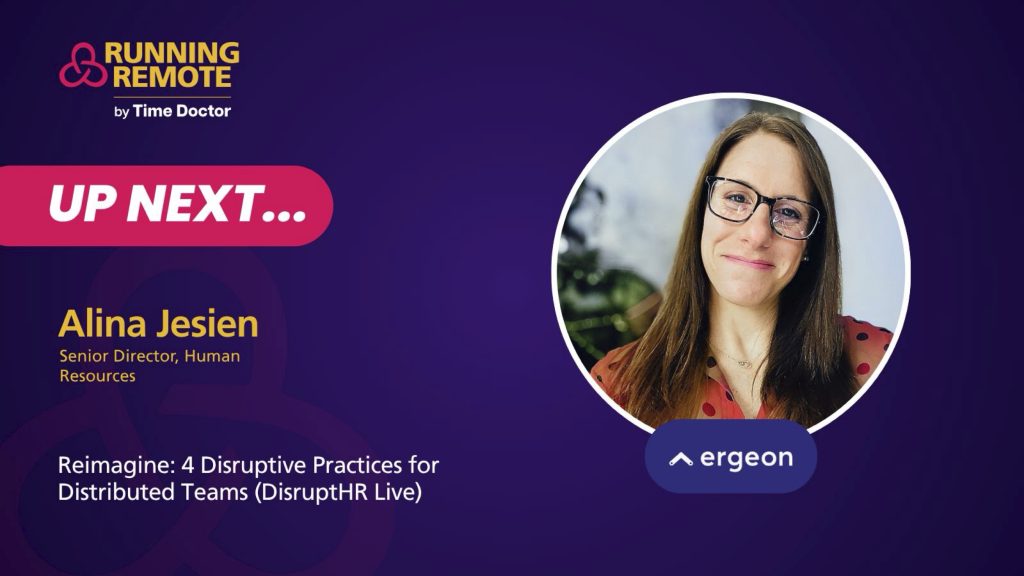
Alina Geshen’s talk opened with a striking statistic from her company’s CTO: 80-90% of institutional knowledge was trapped in people’s heads. The company scaled from 360 to 230 people while growing faster — a counterintuitive outcome explained by what the headcount reduction enabled: a deliberate investment in documentation infrastructure that removed knowledge as a bottleneck.
The distinctive element of their approach was treating the knowledge base like software code — building it in GitHub, where every change is reviewed and tracked, invisible edits are prevented, and the history of decisions is preserved. Product changes are documented before processes go live, not after. Questions flow back into the knowledge base to keep content current. An AI agent was built on top to provide instant answers, freeing managers to shift from information transfer to actual performance management conversations.
The result: managers who previously supervised three direct reports now manage fourteen. The constraint was never capacity — it was the time those managers spent answering questions that should have been documented. An IBM study of 300 organisations found AI transformation is 5-10% technology and 90% change management. Context is the bottleneck. The knowledge base is how you fix it.
Designing intentional in-person moments
Gabrielle Caron from 1Password made a point that is easy to overlook: remote teams have extremely well-developed rituals for virtual work — all-hands cadences, one-on-one rhythms, Slack emoji cultures — but treat in-person moments as if connection will happen automatically once people are in the same room. It often doesn’t.
She described a Chicago offsite that received feedback primarily characterised as exhausting. The gathering was not designed for what it needed to produce. Months later, when real work pressure forced genuine collaboration, the team connection that should have been built in-person finally emerged — but only because the work created the necessity.
1Password now approaches in-person moments with the same design rigour as remote work. Clear objectives. The right people in the room. Engineered interactions built around role collaboration needs. Pre-briefing before anyone arrives. Relationship mapping to identify where connections are weak and need strengthening. The central question: what will change because we met in person? If you cannot answer that before the event, you are not designing the gathering — you are hoping proximity does the work for you.
People-first workflow design
Jacqueline Sinek from Webii shared a shift from the traditional workflow model — assign work, deliver, annual feedback — to a people-first approach centred on who is experiencing the work and how.
Her team asks different questions: what is your favourite type of project? What are your current roadblocks? What would you like to do that is not in your job description? Then, critically, they listen for patterns rather than discarding responses. Three work style archetypes emerged: builders (who thrive in production mode), collaborators (who need connection to do their best work), and big picture thinkers (who need strategic context to stay engaged). Each requires different communication approaches, different visibility structures, and different definitions of meaningful work.
The outcome metric: team members at Webii average more than ten years of tenure. That retention is not an accident. It is the direct product of building workflows around how people actually want to work rather than how the organisation finds it convenient to deploy them.
Remote communication archetypes
James Reddinger’s talk covered something most distributed teams recognise immediately but rarely name: the communication archetypes that break trust and slow work.
The clickbaiter: opens a conversation thread with something alarming that turns out to be trivial after thirty minutes of building suspense. The ghost: does not respond. The efficient non-communicator: one-word responses ending in periods that read as hostile regardless of intent. The spotlighter: sends messages one fragment at a time, creating notification noise. The novelist: three-page emails with the actual request buried on page two.
His point was not to judge these patterns but to understand that in remote environments, tone is invisible by default. Leaders do not just send messages — they control how messages are received. Building that awareness, and modelling clear, purposeful communication, is one of the highest-leverage leadership behaviours available in a distributed context. Effective communication serves three purposes: inform, engage action, and anticipate questions. If a message does not do all three, it is incomplete.