Three years ago, Zapier ran hackathons. The sessions were focused on problem-first building, and they revealed something the leadership team hadn’t fully anticipated: significant variation in how team members understood what business problems were worth solving, and what good looked like. That early observation shaped everything that followed.
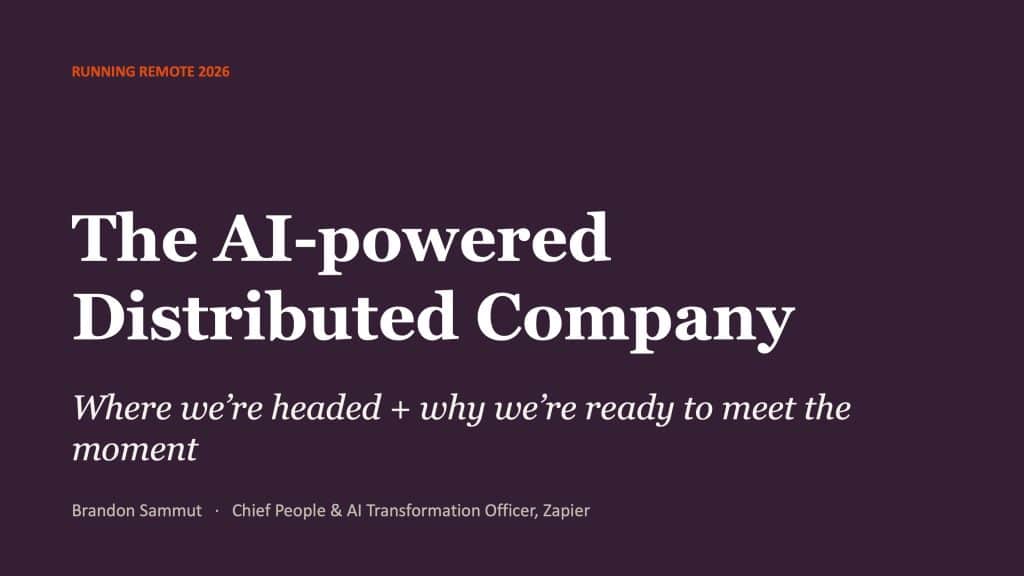
At Running Remote 2026, Brandon Sammut, Chief People and AI Transformation Officer at Zapier, gave one of the most data-rich, operationally grounded presentations of the conference. Zapier is an 800-person, all-remote company operating across 42 countries, with an unchanged mission: making automation work for everyone. And that mission, Sammut argued, is exactly why they were built for this AI moment.
A new kind of hybrid
The framing Sammut opened with reoriented the room. The original hybrid debate — where work happens — is largely stabilising. About 25-27% of knowledge workers are now fully remote, and that number is holding even amid return-to-office headlines. The new hybrid question is different: who does the work? Humans alongside AI. That shift is the story.
Even among Fortune 100 companies, 71% now have meaningful flexibility in their work model. That is not reversing. What is changing is the definition of what a distributed company actually does.
The four ingredients for AI impact
Sammut was precise about what drives real AI transformation, and it is not primarily a technology question. Four ingredients matter in order of importance: leadership clarity on what AI is for; talent and culture — humans who understand how to orchestrate work with AI; tools; and governance, which means building accountability structures for powerful technology.
Miss any one of these and sustained progress stalls. And roughly 80% of the recipe involves human-centred elements rather than technical implementation. This was one of the session’s most useful frames: if your AI programme is stuck, the answer is almost certainly not a different tool.
The results at Zapier
The case study numbers were significant. 97% of Zapier employees — including accountants, recruiters, lawyers, salespeople, and marketers — now use AI coding tools connected to company context. Not just engineers. 88% report measurably improved performance.
Across the organisation: the talent team cut 90% of time to post jobs (designed by a recruiter, not engineers); Revenue Operations saved 5 FTEs — 200 hours per week — through AI agents; Finance reduced book-closing time by 25%; Engineering saw an 11% productivity improvement focused on quality, not just speed; Customer Support answers tickets twice as fast while improving satisfaction scores, with employee engagement rising 20-30 points during the workflow transformation.
Sammut’s framing on time savings was useful: time saved is raw material for impact, not the value metric itself. The question is what teams do with the reclaimed time. Zapier’s answer has been deeper candidate sourcing, predictive analytics, and better customer outcomes — not headcount reduction.
Culture wins the day
Three cultural ingredients proved essential: experimentation (what happens when someone tries something and it doesn’t work?), intellectual honesty (as humans move further from direct work execution, the pressure to inflate results grows — rigor matters more), and psychological safety (when change is fast and stakes feel high, the willingness to disagree with leaders becomes fragile).
Zapier made practical changes to all three after taking an honest look three years ago. Senior leaders, including the CEO, publicly share demos that didn’t work, get stuck on Slack in public channels, and model the wayfinding process rather than projecting certainty. That behaviour changed the culture more than any policy.
The operating framework
Two principles anchor all AI decisions at Zapier. First: you can delegate work to AI, but not accountability. All output rolls up to a person. Second: curiosity beats confidence. Critical thinking is incentivised, not just optimism.
Every AI implementation at Zapier must improve results in three areas simultaneously — efficiency, quality, and employee experience. Not one or two of them. All three. Teams are required to publicly document how a proposed change will deliver across all three metrics before implementation begins. This framework is less than a year old, but it has already changed how conversations about AI are structured across the company.
Why distributed leaders are built for this
The session ended with something worth holding onto. Distributed organisation leaders possess three structural advantages in the AI moment: a documentation culture that serves both humans and AI equally well; experience handling nuance across diverse global teams; and a deep orientation toward outputs over inputs. These are not advantages that remote-first companies developed by accident. They are the foundations of how distributed work functions. And they are exactly what effective AI transformation requires.