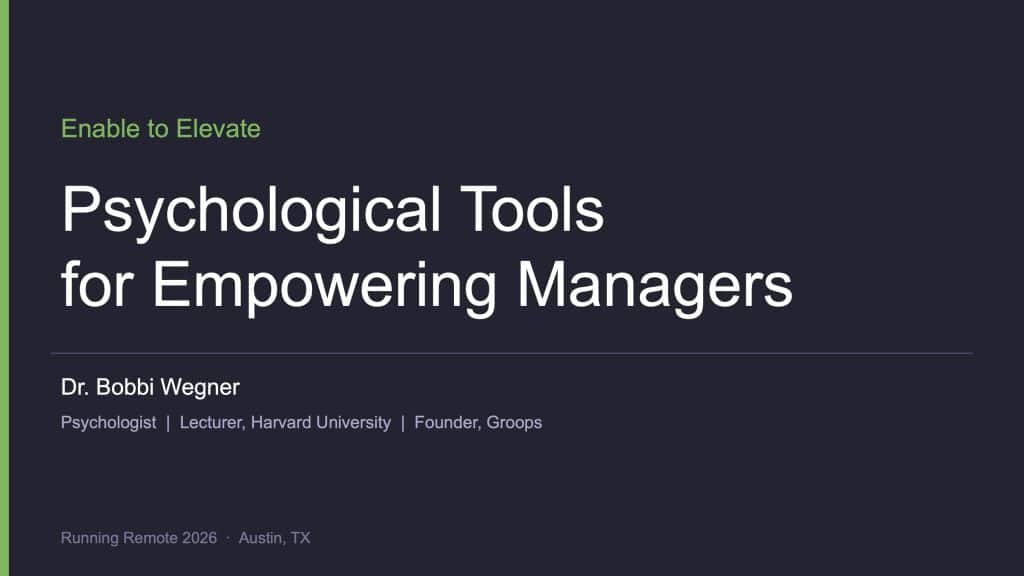
77% of employees worldwide are not engaged. That statistic from Gallup has been quoted in so many presentations that it risks losing its impact. Bobbi Wegner, clinical psychologist and lecturer at Harvard, opened with it anyway — and then did something more useful than most people do with it. She explained why it is true, and what distributed leaders can actually do about it.
At Running Remote 2026, Wegner brought a perspective that was genuinely different from most sessions at the conference: she is not a technology leader, not a COO, not a scaling story. She is a psychologist who works with executives and organisations on the human mechanisms that drive or undermine team performance — and she applies that to distributed work with rare specificity.
Connection and cohesion are not the same thing
The session opened with a distinction that immediately useful for anyone managing a remote team. Connection is about belonging: feeling seen, known, and like you matter to the group. Cohesion is about functioning: trust, alignment, and moving in the same direction together. Both matter. Both can be measured. And distributed work makes both significantly harder to build by default.
An audience poll revealed that the room’s teams averaged 7.35 out of 10 for connection and 6.45 out of 10 for cohesion. Room for optimisation, as Wegner put it. Low cohesion teams exhibit a recognisable pattern: low engagement, retention issues, performance problems that go underground because people lack the psychological safety to raise them. The problems do not disappear. They compound in silence.
What distributed work took away
The core challenge is structural. In co-located environments, connection happened through informal touchpoints — the unplanned lunch, the conversation on the way to a meeting, the accidental encounter in the kitchen. Remote work eliminated most of that infrastructure automatically. The industry has responded by investing heavily in operational tools: async meeting software, project management platforms, cross-border hiring solutions. What it has almost entirely neglected is developing managers who can actually lead for cohesion. That is the skills gap.
Most managers were promoted for their individual contributor skills. What they were not trained for — and what a distributed environment requires — is the ability to harness the power of a group, which is a completely different capability. Groups have their own dynamics, their own emotional weather systems, and their own needs that are distinct from the sum of individual needs.
The neuroscience that explains why directive leadership fails
Wegner walked through the brain science behind what happens when psychological safety is absent. The amygdala — the threat detection system — and the frontal lobes — where creativity and executive functioning live — work inversely. When the amygdala is active, the frontal lobes go quiet. Leaders who create urgency without safety, communicate unpredictably, or respond to challenge with shutdown are literally activating the threat response in their teams. Innovation cannot happen in that state.
The particular risk in remote environments: leaders often activate the amygdala without intending to. A message that goes unanswered. Feedback delivered in a tone that reads as cold over text. An absence of acknowledgement when something went well. In co-located settings, these moments get corrected by proximity and facial expression. In distributed work, they sit in the silence.
Practical tools that make a real difference
The coaching skills Wegner outlined are drawn from motivational interviewing, a clinical technique that has been adapted for organisational contexts. The core principle: ask more than you tell.
The protocol is simple and teachable. Ask open-ended questions — what, how, why — rather than closed ones that invite yes or no. Make reflective statements that show you have heard what was said. Summarise the conversation. Then, and only then, move to action.
Most managers jump to solutions. They hear a problem and immediately begin solving it, which feels helpful but frequently misses the actual issue and signals that the conversation is closed. Asking two open-ended questions before offering any advice produces dramatically different outcomes — both in the quality of information gathered and in the quality of the relationship.
The 80/20 rule is the simplest heuristic from the session: listen and ask questions 80% of the time. Advise only 20%. That ratio feels uncomfortable for managers who have been rewarded throughout their careers for having answers. But in distributed environments, it is the ratio that builds the kind of team that can think independently and surface problems before they become crises.
Building intentional routines
Connection in remote settings has to be designed, not backed into. Wegner recommended practical rituals: starting meetings with a simple check-in question (she uses a 0-10 scale for how people are feeling), closing with a relational touch point, and moving toward relationships when things break rather than retreating to task.
The habit of jumping straight to business on calls — in the name of efficiency — is one of the most common ways distributed managers inadvertently signal that the person on the other end is a resource rather than a colleague. Two minutes of genuine contact at the start of a call changes the quality of everything that follows.
The ROI on middle manager development
The closing argument Wegner made was simple. In distributed work, investing in the middle manager has one of the highest returns of any people intervention available. The reasons that proximity used to serve — the informal coaching, the relationship building, the constant small signals of belonging — no longer happen automatically. Every function that proximity used to perform now needs to be intentionally delivered by a manager who has been trained to do it. Most have not been. That is the gap this session was designed to start closing.