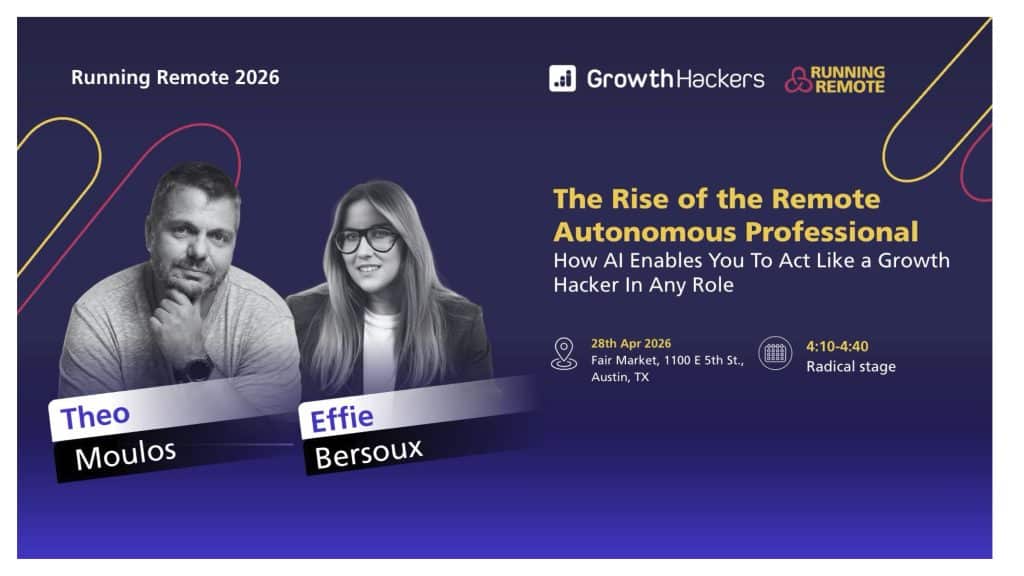
Growth hacking started as marketing done by engineers — a methodology borrowed from software development’s agile approach and applied to customer acquisition. For years, it required technical fluency that most non-engineers didn’t have. What Theodore Moulos and Effie Bersoux argued at Running Remote 2026 is that AI has changed this fundamentally, and the change is larger than it might initially appear.
The divide that has defined professional work for decades — engineers who build but can’t market, marketers who understand audiences but can’t build — is collapsing. The Remote Autonomous Professional emerges from that collapse.
From SaaS to Service as Software
Moulos traced a conceptual shift that frames what AI has changed. For years, professionals used SaaS — Software as a Service — tools built by engineers to enable non-technical work. You got access to capability someone else built.
AI inverts this. With AI, non-technical professionals can now build the capability themselves. The concept the speakers used is Service as Software: your deep domain knowledge plus AI tools allows you to create services and products that previously required engineering resources. A marketer who understands their audience can now build the targeting system. An HR professional who understands their hiring process can now build the screening tool.
This created a new professional category that the Growth Hackers community of 140,000 members worldwide is living in real time: people with deep domain knowledge who want to build systems from that knowledge, without requiring technical or marketing training that isn’t relevant to their actual problem.
The builder versus executor divide
The defining split in the current moment, the speakers argued, is not between technical and non-technical workers. It is between builders — professionals who systemise their work, their department, their workflows — and executors, who use AI as a tool without creating systems from it.
The question that defines what side of this divide you are on has changed. The old question was: how many people are in your company? The new question is: have you built your own system? How well is your system built?
This is not an abstract philosophical distinction. Companies on opposite sides of this divide are operating at fundamentally different levels of output and leverage. Builders create compounding advantages. Executors remain dependent on the system someone else built.
AI agents as team members
Moulos walked through how Growth Hackers manages a fully remote team across twelve time zones, which is one of the hardest coordination challenges in distributed work — stand-up meetings become nearly impossible when the overlap is less than an hour. Their answer was to automate the coordination infrastructure.
A signals tracking system logs day start and end procedures and alerts supervisors to incidents automatically, solving the problem of performance reviews being dominated by recency bias because everything from the past six months now lives in a queryable record rather than a manager’s memory.
On AI agents more broadly: the speakers were careful to note what agents cannot do. They cannot create strategies. They cannot make final decisions. They mix contexts and miss nuances that humans understand implicitly. What they are exceptional at: analysing massive data volumes, monitoring for anomalies at scale, executing tasks that would otherwise require human hours, and — critically — not forgetting.
The traffic loss problem that is coming for every content business
One of the most practically alarming parts of the session was the Mindvalley case study. When Google introduced AI Overviews — which answer search queries directly without requiring users to click through to websites — Mindvalley experienced a 50% drop in website traffic. For a company whose revenue flows through website visits, this was existential.
After extensive optimisation work, they recovered 5% of that traffic through ChatGPT. 45% remains unrecovered.
The session’s implication was clear: every organisation with a content-driven acquisition strategy needs to understand LLM optimisation now, not when the traffic loss arrives. This means understanding how to structure content so it appears in AI-generated answers, optimising for Bing (which powers ChatGPT’s ranking), and rebuilding conversion strategy for the visitors who do still arrive — because if fewer people visit and the ones who do don’t convert, the business model breaks.
The most important skill in this environment is not knowing how to use a specific AI tool. It is knowing what to build — which requires the domain expertise to understand what your organisation actually needs and the builder mindset to use whatever tools are available to create it.