Performance management was already broken before remote work arrived. Office environments just hid it well. When companies went fully remote in 2020, they lost the physical proxies they had always used — the visible activity, the seen presence, the impression of busyness — and discovered that most of what they called performance measurement was actually proximity measurement.
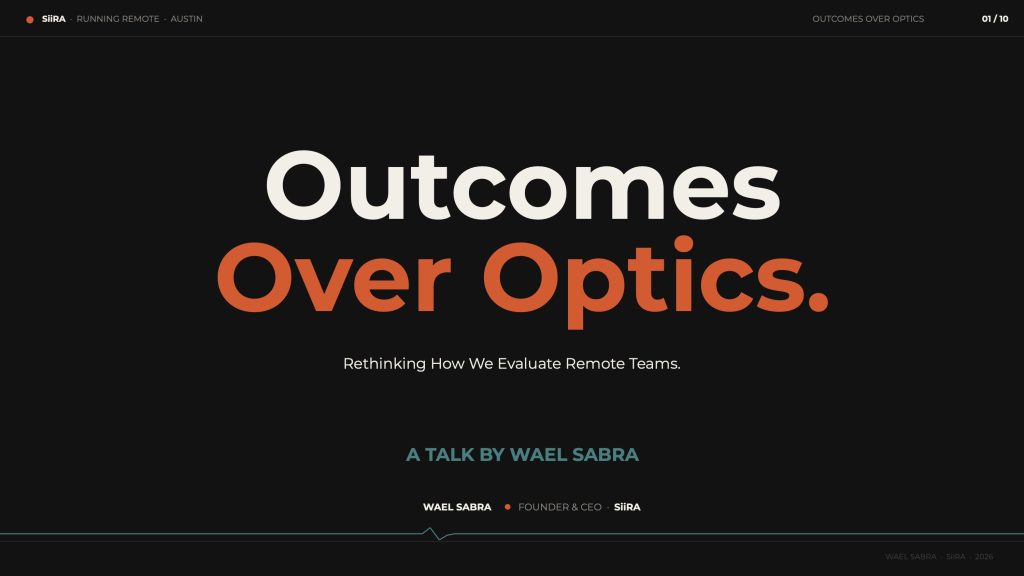
At Running Remote 2026, Wael Sabra, CEO of SIIRA, gave a presentation that was simultaneously diagnostic and practical. The diagnosis: traditional performance management is fundamentally inadequate for distributed work, and AI is about to make the problem dramatically worse. The prescription: a clear, achievable shift to outcomes-based evaluation built around three specific principles.
The problem has always been there
Sabra opened with an observation that reframes the entire conversation. Distributed companies often accept blame for creating performance measurement problems. They should not. Remote work did not break performance management. It exposed the existing problem by removing the concealment that office environments provided.
In offices, proxy signals substitute for real measurement without anyone noticing. The person at their desk looks engaged. The person in meetings looks active. The person who arrives early and leaves late looks committed. None of these signals tell you whether the work is actually good. They tell you whether the person is physically present and performing presence. When remote work removed the physical visibility, organisations tried to recreate the same signals digitally — Slack green dots, camera usage, late-night emails — and produced the same meaningless noise in a different medium.
Sabra’s company, SIIRA, came to this problem from an unusual angle. They realised they could measure a $15 banner ad with precise instrumentation but could not measure a $200,000-per-year remote engineer with the same clarity. That asymmetry — accurate for assets, opaque for people — is the foundational problem.
AI will make it worse before it gets better
The warning at the centre of the presentation: AI will completely break traditional performance signals, and most organisations are not prepared for it.
The dynamic is counterintuitive. Top performers using AI will complete in 10 hours what previously took 80 hours. Under traditional measurement, they will appear to be doing less — fewer hours logged, fewer tasks visible in the queue, more capacity. Lower performers without AI will look roughly the same as they always have. The traditional signal inverts. The people delivering the most value will appear to be contributing the least.
OKR frameworks, goal-setting systems, logged hours, and most standard performance tools were designed assuming office-based work with natural asynchronous interaction and ambient visibility. They assumed the context of physical co-presence. Remote work has already strained them. AI will render them obsolete.
A case study worth keeping
Sabra shared a story that illustrated the problem more clearly than any framework. A client brought him a concern about Mark, a newly hired engineer who appeared to be underperforming. He was disengaged, not participating, possibly working multiple jobs. The manager was considering termination.
Sabra asked a single question: What is Mark responsible for? The answer could not be cleanly articulated, despite role descriptions, onboarding documents, and Slack conversations. There was no single clear statement of what Mark was supposed to deliver.
After resetting expectations and defining outcomes explicitly — two questions: what is the goal, and when do we call it achieved — Mark went from near-termination to top performer within one month. Same manager. Same company. Same team. The problem was not Mark. It was clarity.
The outcomes-based framework
Sabra’s alternative has three characteristics: clear, natural, and frequent.
Clear means answering two questions for every role: what are we trying to achieve, and when will we know we’ve achieved it? Not a mission statement. Not a list of responsibilities. A specific, understandable goal and a specific definition of success. If you cannot explain it to a ten-year-old, it is not clear enough.
Natural means using systems that already exist in the work. Engineering outcomes live in Jira. Sales outcomes live in the CRM. Operations outcomes live in ticketing systems. These platforms capture every relevant data point. Adding a separate performance management layer on top creates friction, duplication, and the very disconnection from work that makes performance conversations feel abstract. Integrate the evaluation into where the work actually happens.
Frequent means small, rapid feedback cycles — two to four weeks rather than quarterly or biannual reviews. This mirrors a shift already visible in education: infrequent high-stakes exams are being replaced by continuous low-stakes assessment that gives clearer signals and allows faster course correction. The same principle applies to performance. Quarterly reviews are almost always reviewing problems that were visible weeks earlier but went unaddressed because the next cycle was too far away.
The steady outcome signal eliminates several of the most uncomfortable features of traditional performance management: conversations about goals set in a business context that no longer exists, disagreements about whether something counts as complete, and the awkward asymmetry between manager and employee who have fundamentally different views of the same performance period.
What this requires from leadership
None of this works without a willingness to define outcomes with real clarity up front. That is harder than it sounds. Vague role descriptions, poorly specified expectations, and ambiguous success criteria are organisational features, not edge cases. They are the norm. Outcomes-based management forces organisations to fix this — and in doing so, it addresses the performance measurement problem at its actual source: the absence of clear expectations, not the absence of visible activity.
Sabra’s closing point was simple. Outcomes are the only thing that transcends the changes in how, where, and by whom work gets done. They work with remote teams. They work with AI-assisted work. They will work with whatever comes next. Building performance systems around them is not a nice-to-have. For distributed companies operating in an AI-accelerated environment, it is the only approach that will hold.