
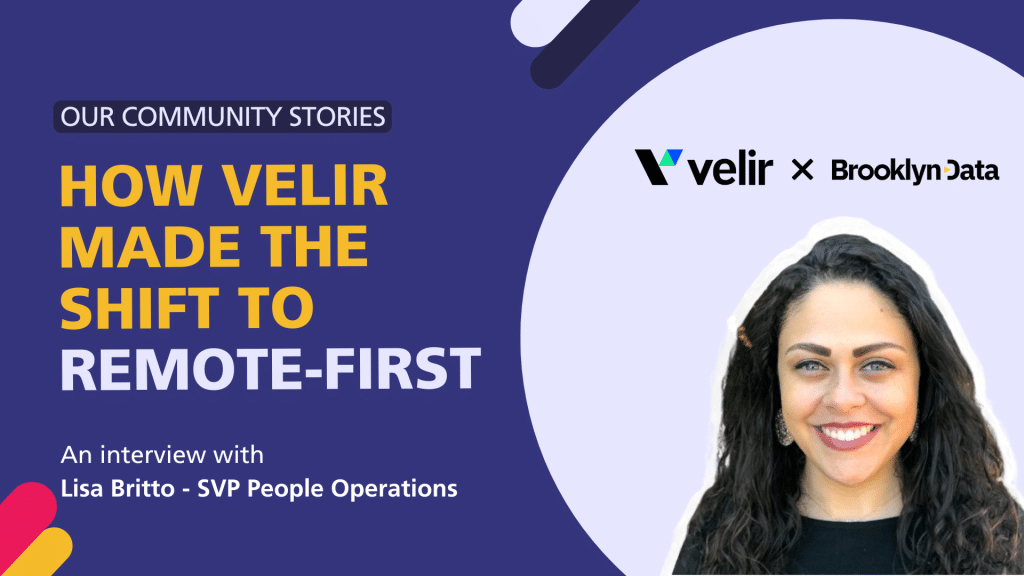
Published as part of our Running Remote Community Stories series — spotlighting the companies building the future of distributed work together.
Velir has spent nearly 25 years building digital experience platforms from their base in Somerville, MA. Today, they’re known for thoughtful culture, people-first leadership, and strong technical depth across Acquia, Snowflake, dbt, Next.js and more. But in 2026, they’re entering a new chapter: closing their Boston HQ and going fully remote-first.
This shift didn’t happen overnight. And it didn’t happen alone.
The Running Remote Community played a real role — offering data, peers, benchmarks, and support during a moment when the external narrative around remote work was getting louder and more confused.
👉 Learn more or join the community here: https://runningremote.com/community/
Read the full interview with Lisa Britto, SVP of People Operations at Velir, on how the decision came together, what changed internally, and why clarity came from hearing directly from other leaders who’ve done it.
__________________________________
Interview: Velir’s Path to Remote-First
Setting the Stage
What was Velir’s setup before deciding to go remote-first? How were you feeling about being partially or fully in-office versus remote?
Lisa Britto:
Velir shifted to remote work during Covid, though we kept our Somerville office, opting for what was then a smaller space, since our employees were still local. Over time, more of our team either moved out of state or joined us from across the U.S. With the acquisition of Brooklyn Data Co. in 2023, our footprint expanded even further, adding teammates in the UK, Canada, El Salvador, and beyond.
That said, we still had a core group of local employees, so the office remained open. But in reality, aside from a few hosted events and our monthly all-hands, the space saw less and less day-to-day use. At times it felt like tumbleweeds could roll right through.
The Turning Point
What shifted your thinking toward going fully remote? Was there a moment, data point, or insight that helped tilt the scale?
Lisa:
In the beginning, we explored both local team gatherings and virtual events for our colleagues spread across the country. While well-intentioned, this hybrid approach proved difficult to sustain, especially with economic headwinds, and often led to uneven participation.
Velir has always been a remarkable company — one of our teammates just celebrated 22 years here — and much of that is thanks to the strong foundation built under our former CEO’s leadership. The real turning point, though, came with the transition to our new CEO, Wendy Karlyn, whose fresh perspective and forward-looking approach encouraged us to evolve with the times.
Together, with the steady partnership of our CFO, we were able to look closely at both the internal data on our shifting workforce and external benchmarking from the Running Remote community. This gave us the clarity and confidence to embrace a remote-first model as the right next step for our future.
Role of the Running Remote community
At what point did you lean on the community? Was it for stats, benchmarking, storytelling, or confidence? Can you share a specific moment or insight that stuck with you? Could you name some of the members helping you move the needle?
Lisa:
I’ve been part of the Running Remote community for several years now, and I’ve been primarily remote since 2016. For me, it’s more than just a network — it’s a proving ground of ideas, data, and lived experience. As an HR leader, it has given me the benchmarking and insights I need, but also the confidence that comes from learning alongside senior leaders who are actively building the future of work.
Kasia Triantafelo, the Running Remote Community leader, has been instrumental, always connecting me with the people who’ve navigated the same challenges and come out stronger. The senior HR leaders group has been especially powerful, helping me reclaim my confidence when doubt crept in. I’m deeply grateful to peers like Andrew, Dajana, Luca, and so many others whose generosity in sharing both wins and struggles reminds me that none of us are doing this alone.
And at the moment when the broader narrative has been tilting against remote, I reached out to Liam Martin, who co-founded the Running Remote community and events, as well as the workforce analytics platform Time Doctor. His conviction — that remote work isn’t just viable but essential — reignited my determination to ground every decision in truth and data. Because the reality is undeniable: as an example, women are leaving the workforce in alarming numbers as companies push people back into offices and they’re forced to take on the main caretaking responsibilities. And productivity? That’s not the issue, matter of fact with remote work, according to multiple sources, productivity increases. But, as my CEO says: “That’s a forcing function. And isn’t that what we should want? To build workplaces that are intentional, equitable, and built to last?”
Pain points & myths
What doubts or misconceptions did you face about remote-first (cultural gaps, productivity concerns, management hesitations)? How did you address them?
Lisa:
There’s no shortage of false narratives about remote work, and let’s be honest, change can feel daunting. Naturally, there were management hesitations: How do we onboard and train people effectively? How do we sustain culture and connection without a physical office? These are real questions, and I won’t pretend we’ve solved for them all. Making the call to go remote-first was only step one; the real work begins now.
What excites me is that we’re leaning all the way in. We’re redesigning our communication and engagement strategies, rethinking how we tell our story, and intentionally creating a workplace where people can thrive regardless of location. The data is clear — remote works. Now it’s about harnessing that data to reshape how we collaborate, connect, and show up for one another. And I have no doubt we’re ready for the challenge.
Decision time
What went into deciding to close the Boston HQ and commit to remote-first starting 2026? How did you weigh culture, logistics, leadership alignment?
Lisa:
The decision to formally close our Somerville office and fully embrace remote-first came down to three things: data, logistics, and leadership alignment. The majority of our team is no longer based in Massachusetts, and we recognized that if we want to support everyone equitably, we have to think differently about how we work.
There were also very practical considerations. Maintaining an underutilized office no longer made financial sense, especially when those resources can be reinvested into our people, technology, and systems that strengthen how we connect and collaborate as a distributed organization.
At the same time, our culture has already been shifting. Many newer team members have never set foot in the MA office, and with the acquisition of Brooklyn Data Co., we’ve embraced the need to blend the different cultures, perspectives, and ways of working into something new. Layer in recent leadership changes, and it became clear this was an important moment to embrace evolution rather than resist it.
Our leadership team is aligned around the future: asking how we lead differently in a distributed world, how we ensure no one feels left behind, and how we foster community without relying on geography. Moving remote-first is not just a logistical choice — it’s a cultural commitment to bring everyone along and shape a future that works for all of us.
Early results & reactions
Since the announcement, what positive feedback or momentum have you seen — from your team, your clients, or internally?
Lisa:
Since we shared the news, the response has had a little bit of everything. Some folks are excited, some are nervous, and a few are genuinely sad to see the office chapter close. And honestly, all of that makes sense. This place has been part of people’s lives for a long time.
What’s been really encouraging, though, is the momentum that’s followed. Once the initial “wow, this is really happening” settled in, people started leaning into what this shift could make possible. I’ve heard teammates talk about feeling more included now that we’re designing everything with a distributed workforce in mind.
Inside the company, you can feel this quiet but steady energy building as teams start imagining how we evolve connection, culture, and collaboration without a physical space in the middle.
So yes, there’s nostalgia. But there’s also a very real sense of new beginnings.
Advice to others
If another HR or People Ops leader is on the fence about going remote-first, what would you tell them? What advice would you give?
Lisa:
If another HR or People Ops leader is on the fence, I’d tell them to start by getting clear on what they’re really afraid of and what genuinely excites them. Most of the hesitation isn’t about remote work — it’s about stepping into the unknown.
For me, the shift energizes me. Remote-first forces you to be intentional, creative, and grounded in real data instead of old habits. When you look at the facts with fresh eyes, it becomes much easier to see what’s true and what’s just fear nudging you to stay comfortable.
And here’s the thing — you don’t have to figure it out alone. The Running Remote community has been a huge source of support for me, offering not only the data to back up decisions but also the lived experience of people who’ve navigated these same questions. There’s a whole ecosystem of insights and encouragement waiting for you there.
So let curiosity lead. Let data calm the nerves. And let the excitement of building something more intentional and inclusive guide you forward.
Looking ahead
How are you planning to preserve or evolve your culture and collaboration as you make this shift?
Lisa:
We’re looking at everything through a fresh lens. A remote-friendly lens. This shift gives us an opportunity to rethink how we connect and collaborate in ways that are more intentional and inclusive than what an office ever allowed.
Sure, we may not have the classic watercooler moments anymore, but we can create new versions of them. Tools like Donut can spark fun icebreakers and conversation topics in Slack so people can meet organically across teams. And while you can’t stroll past someone’s desk for a quick hello, we can set up regular coffee chats that pair teammates from different departments, countries, and backgrounds. The kind of connections that simply wouldn’t have happened by chance in an office.
We’re also taking a close look at how we communicate, how we celebrate, and how we create space for people to show up as humans, not just coworkers. Remote-first doesn’t diminish culture — it asks us to design it with intention. And that’s exactly what we’re doing.
You Don’t Have to Build This Alone
Lisa’s story is exactly why the Running Remote Community exists — a private space where HR leaders, founders, and workplace operators help each other build workplaces that work for everyone.
If you want benchmarking, peer input, or clarity on your next step:
👉 https://runningremote.com/community/

Download the Remote Playbook
Velir is one of the companies featured in our Running Remote Playbook — a practical guide written with the operators of our community, who’ve built distributed teams at scale.

