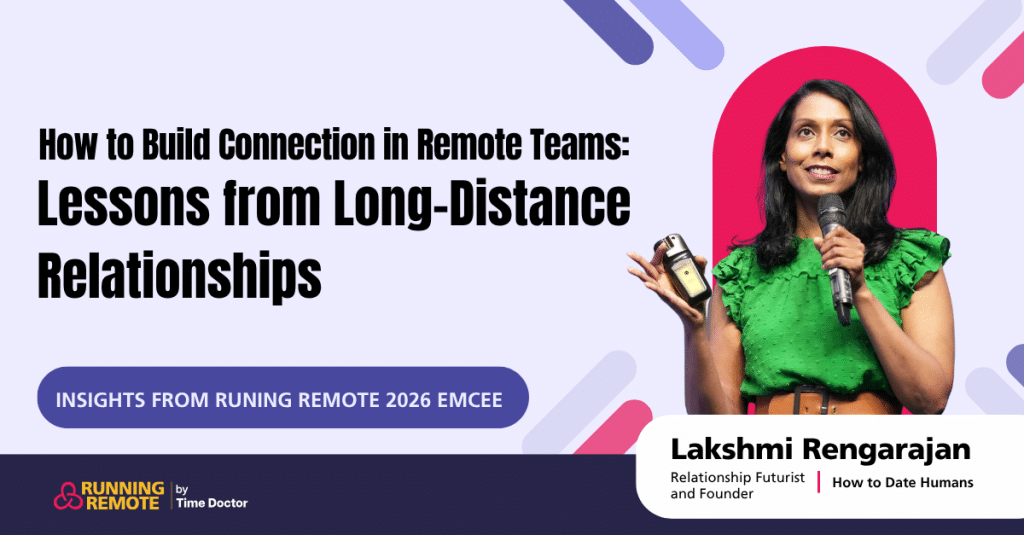
A conversation with our EMCEE, Lakshmi Rengarajan, at Running Remote 2026
On April 28th, Lakshmi Rengarajan will take the Radical Stage for her keynote, “What Remote Teams Can Learn from Long-Distance Relationships.” She will also serve as the Master of Ceremonies for the Radical Stage across both days, guiding conversations and helping weave together some of the most forward-thinking sessions at the event.
At Running Remote 2026, we’re bringing voices to the stage that challenge how we think about work. Lakshmi is one of those voices.
A relationship futurist and connection expert, Lakshmi studies how humans form meaningful relationships in the age of technology — and translates those insights across dating and workplace dynamics. Her career spans designing in-person dating experiences, working at Match.com, leading workplace connection at WeWork, and hosting podcasts like The Later Dater Today. Across all of it, one theme stands out: connection doesn’t just happen — it has to be understood, designed, and maintained.
In this conversation, we explore what remote teams can learn from long-distance relationships — and why most organizations are still solving the wrong problem.
__________________________________
Interview:
Why does remote work feel more disconnected than ever?
You’ve spent years studying how people form relationships in the hardest conditions (distance, technology, uncertainty). Why do you think remote work has made connection harder, even though we’re more connected than ever?
Lakshmi:
Because we made the exact same mistake we made with dating apps. When Tinder showed up, everyone thought — great, access solved. Except it wasn’t an access problem. It was a preparation problem. Nobody taught people how to navigate a totally different set of signals, rhythms, and expectations.
Remote work did the same thing. We handed people Zoom and Slack and said “stay connected!” without ever addressing what actually changed about how connection works when you remove a shared physical space.
I always come back to this: willingness to connect is not the same as preparedness to connect. Most companies are very willing. Almost none are prepared.
That’s exactly where my work lives — I help teams understand what actually changed about how connection works so they can stop guessing and start building something that fits the way people relate now, not how they used to.
Communication vs. connection
You often say it’s easy to meet but harder to connect. Where do you see remote teams confusing ‘communication’ with actual connection?
Lakshmi:
Oh, this is my favorite. I wrote “it’s easy to meet but harder to connect” back in 2009 because I was watching people swipe through hundreds of matches and somehow feel lonelier than before. Sound familiar?
Remote teams do the exact same thing — they stack the calendar with 1:1s and standups and retros and then wonder why nobody feels like they belong.
More interaction isn’t more connection. It’s just more calendar.
A person can go on forty dates in a month and still not feel known. A team can have a daily standup and still not know each other.
The question was never “are we talking enough?” It’s “does anyone actually feel seen?
What long-distance relationships get right
If we treated our teams more like long-distance relationships, what would we stop doing immediately — and what would we start doing instead?
Lakshmi:
First thing we’d stop? Treating the offsite like it’s going to save us.
I’m watching organizations do the exact thing long-distance couples do. They often let everything pile up between visits, then cram it all into one high-pressure reunion that’s supposed to fix three months of drift.
The offsite becomes this magical weekend where we’re finally going to reconnect and align and feel like a team again. And then everyone goes home and the slow erosion starts right back up.
Long-distance couples who make it learn something critical: the visit isn’t the relationship. The boring Tuesday night phone call is the relationship. The stuff between the reunions is where the actual connection lives or dies.
The second thing we’d stop is trying to recreate the office on a screen. Every long-distance couple learns this the hard way — you can’t just copy-paste the in-person relationship into FaceTime. You have to build a different relationship, one that fits the container you’re actually in.
What we’d start doing is way more interesting: we’d start by understanding how each person on the team actually connects — not how the company thinks they should — and then figure out how the group connects as a unit.
Those are two completely different questions, and most organizations have never even asked the first one.
That’s a huge part of what I do in my keynotes and workshops — I give teams a framework for actually asking those questions instead of just hoping the next offsite answers them
The future of connection in remote work
You call yourself a ‘relationship futurist.’ Looking ahead 3–5 years, how will AI, async work, and distributed teams reshape how we build trust and connection?
Lakshmi:
Here’s what I know from studying twenty years of “this technology will bring people closer” promises: the technology is never the bottleneck.
Dating apps didn’t make people worse at relationships. They just revealed what was already hard — being known, staying curious about another person, doing the unsexy maintenance work.
AI and async tools will do the same thing for teams. They’ll automate the easy parts and leave everyone standing face to face with the hard part, which has always been the same: can you make another person feel like they matter to you?
The companies that get that right won’t need a futurist to tell them what’s coming. They’ll already be ready for it.
The one skill that matters most
Across everything happening at the Radical Stage this year — from async work to AI to new org design — what’s one human skill around connection that will matter more than anything else?
Lakshmi:
Knowing the difference between doing things together and actually building something together.
I see couples do this all the time — they fill every weekend with activities and trips and dinner reservations, and then one day someone says “I don’t think you actually know me,” and the other person is genuinely shocked.
Teams do the identical thing. Offsites, happy hours, team-building exercises — the activity becomes the alibi for the connection nobody is actually building.
The one skill that will matter most? Being willing to put the alibi down and ask what the relationship actually needs.
Sessions Lakshmi is watching at Running Remote 2026
Looking across the Radical Stage schedule, which sessions grab your attention for those trying to foster deeper human connection in a digital-first world?
🟡 Your Next Coworker Is a Twin: How Zapier Thinks About AI Transformation
Wade Foster, CO-founder & CEO at Zapier
Andrew Warner, Founder at Mixergy🟡 Humans + Machines: Unlocking Performance in Remote Teams
Nadia Vatalidis, Head of People at Doist
Nick Francis, Founder and former CEO at Help Scout🟡 The Evolving Remote Employee Journey: Where AI Meets the Human Experience
Tracy St.Dic, Global Head of Talent, Zapier
Chase Gharrity, VP, People @ Binance.US
Lucy Stein, VP of People, GivebutterAllison Vendt, VP, People Operations & Head of EmployeeScott Aicher, President N America & Board Member, CXC Global
Nawal Fakhaury, Senior Director, Experience & Inclusion, HubSpot
Gianna Driver, Chief People Officer at OpenTable
Moderated by: Mikaela Cohen, HR Brew Reporter
Final thought
If there’s one takeaway from Lakshmi’s work, it’s this:
Remote work didn’t break connection — it exposed how little we understood it to begin with.
And the teams that win going forward won’t be the ones with the most tools, meetings, or offsites.
They’ll be the ones who learn how to actually build relationships — intentionally, consistently, and in a way that fits the reality of how we work now

Ready to rethink your team connection?
Join Lakshmi Rengarajan and 400+ global leaders at Running Remote. April 27-29, 2026 | Austin, TX.